Bluesky discussions at VIS 2026: a retrospective
What worked, what did not, and what it takes to build a conference community online.
Now that I made it back to Pittsburgh after some delay because of the nationwide ground stop in the United States, I wanted to share my perspective on how the discussions went during the IEEE VIS 2026 conference. For context, this is a follow-up to my earlier blog post on why and how we built the integration—I recommend reading it first.
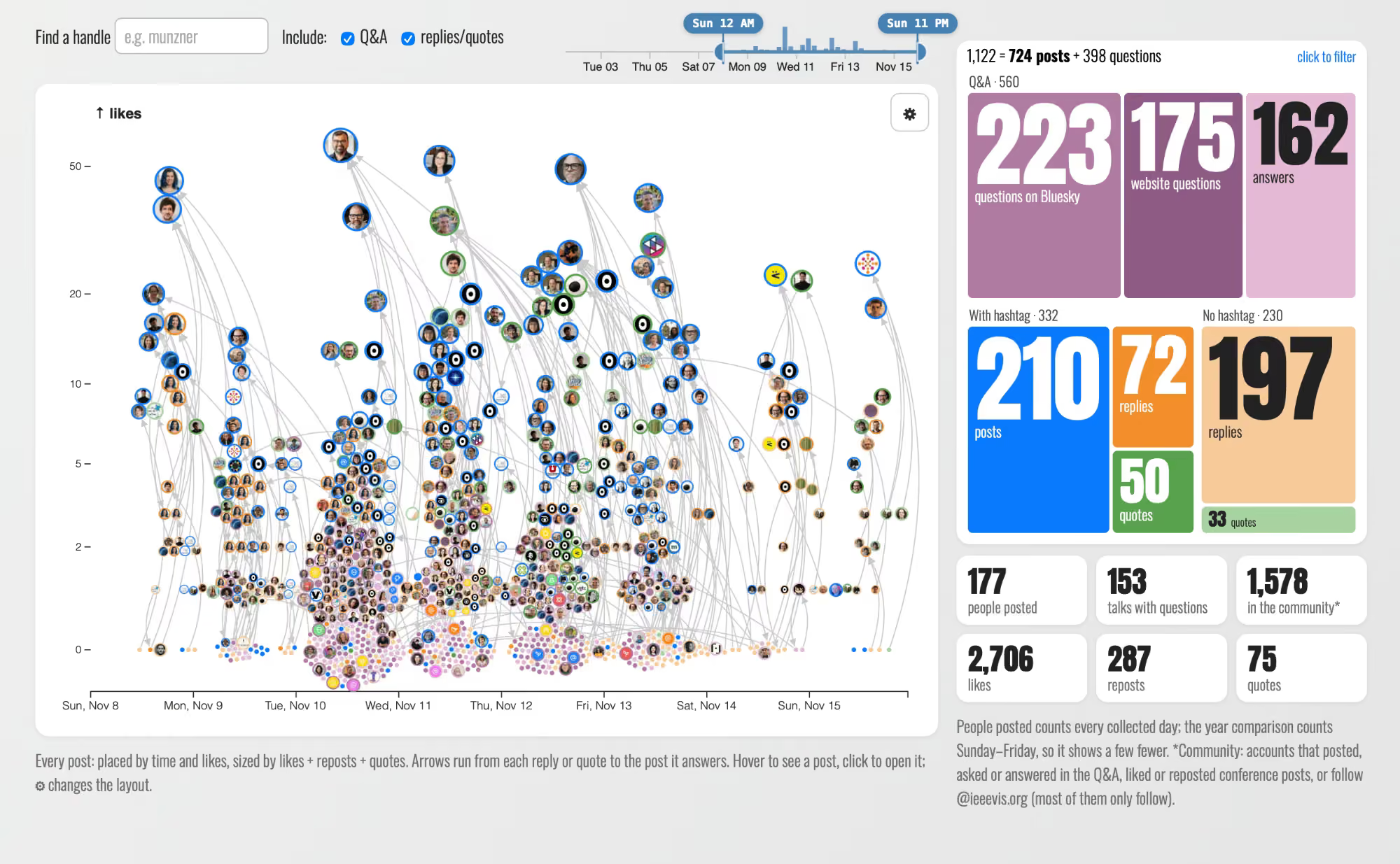
Judging by the numbers (as of today), I think the Bluesky integration for VIS can be considered a success. John Guerra collected and visualized some statistics, and I recommend that you check it out to explore the data. His analysis counts more than a thousand posts related to the conference, including almost 400 questions. The Q&A alone had 560 posts: 223 questions asked on Bluesky, 175 asked through the conference website, and 162 answers. Many people with Bluesky accounts posted from them directly, but more than a third of the replies in the paper threads came through our guest bridge, which lets attendees without a Bluesky account comment with their conference login. In total, 177 people posted, and their posts got more than 2,700 likes and almost 300 reposts. After the conference, there are now more than 1,500 people in the community around IEEE VIS. It was amazing to see how many people created new accounts specifically for this conference and are now engaging in conversations online. While we are still learning as a community how we want to use the discussions, more than 40% of the paper threads had some discussion, and the busiest paper discussion has 19 replies.
If you have any thoughts or additions about this post, please let me know in this Bluesky discussion.
The rocky start: our posting account got suspended during the keynote
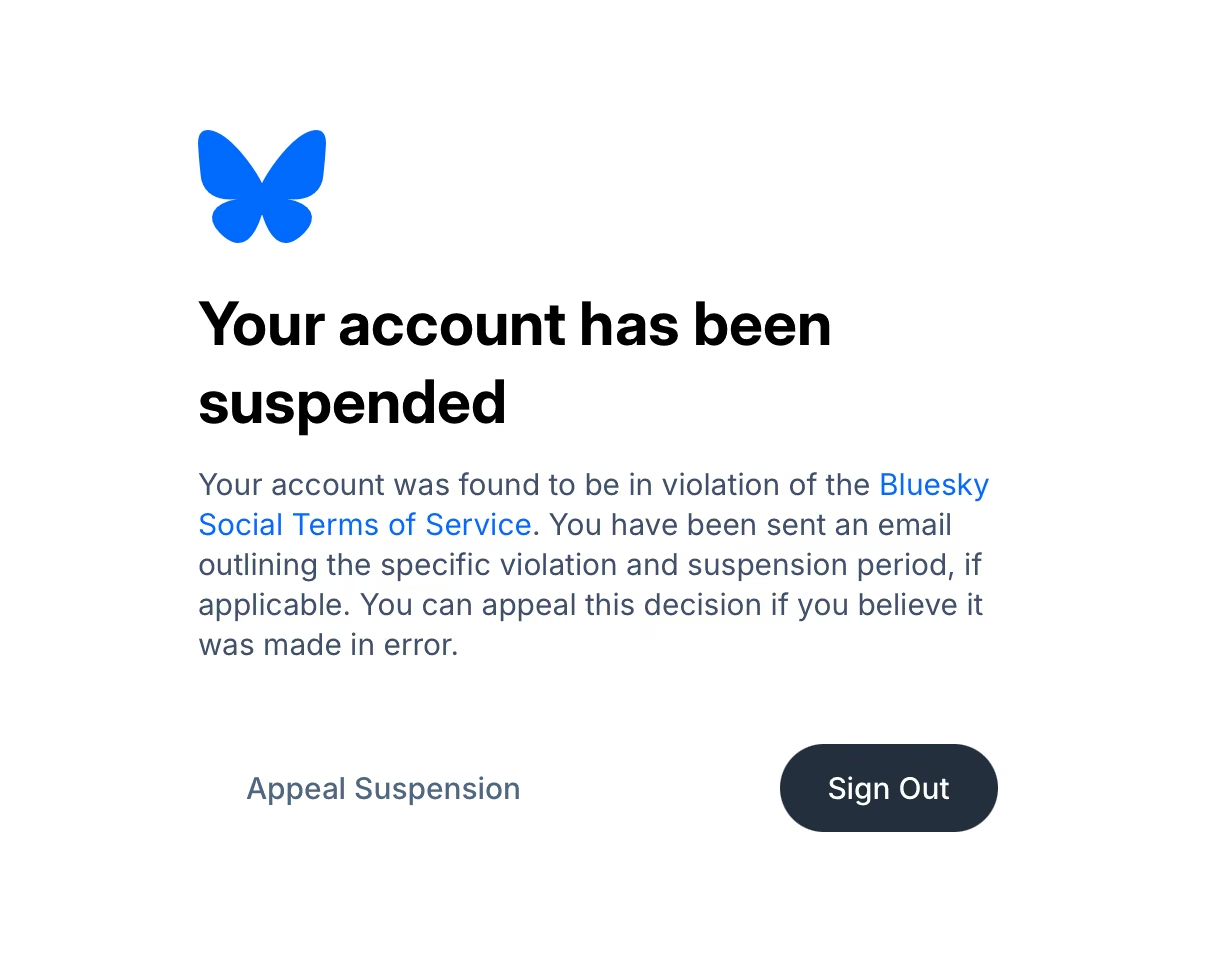
Luckily the rocky start was not something most people noticed. On Tuesday morning, the main conference started with the welcome and the keynote, and during that time our posting service posted the announcements for the papers in the first sessions. As a reminder, we need one Bluesky post for each paper, and we embed the discussion under that post on the VIS website. During the keynote, I was checking the discussions to see whether everything worked and noticed that our posting account was suspended. This meant that the announcements were hidden and new threads could not be posted 😱. I suspect that our account was flagged as a bot because it posted 24 posts in about 10 seconds—which admittedly is suspicious. I was getting nervous at this point, because having no discussions at the start of the conference would have set a bad precedent and kill any momentum for people to engage. I immediately appealed the suspension and was lucky to be able to reach out to Jim Ray from Bluesky Developer Relations. They unsuspended the account within 15 minutes! Jim put a 90-day flag on our account so the bots wouldn’t take it down again. Posting during the rest of the conference went smoothly, even with bursts of more than 30 posts. So a big shout-out to Jim and Bluesky for unlocking the account within minutes.
As a takeaway for other conferences and for us in the future, I recommend contacting Bluesky before the conference so they can mark the bot account as trusted. I also recommend monitoring the announcements and the health of the accounts, so that you can detect when anything goes wrong. Monitoring and observability are probably a good idea for any kind of service running during a conference.
What people said about the Bluesky integration
People had a lot to say about the discussions, some in person and some on Bluesky itself. Here are the main themes.
It brought back the “Vis Twitter” backchannel
Besides a persistent space for paper discussions, a goal of using Bluesky was to bring back the online community we had during the Twitter days. Building a community takes longer than one conference, but the early sentiment is very positive. Arvind called it rebuilding “the conference back channel/lurking and data vis Twitter community of yore”, and others noticed a lot of appetite to recreate the online community of the Twitter days, were crazy to see so much vis content on Bluesky, and loved how active #ieeevis was this year. Patrick Stotz even sees hope for a lively #dataviz community beyond Twitter and LinkedIn. We need to keep the momentum going.
The Q&A integration was well received, and had benefits over mic-only Q&A
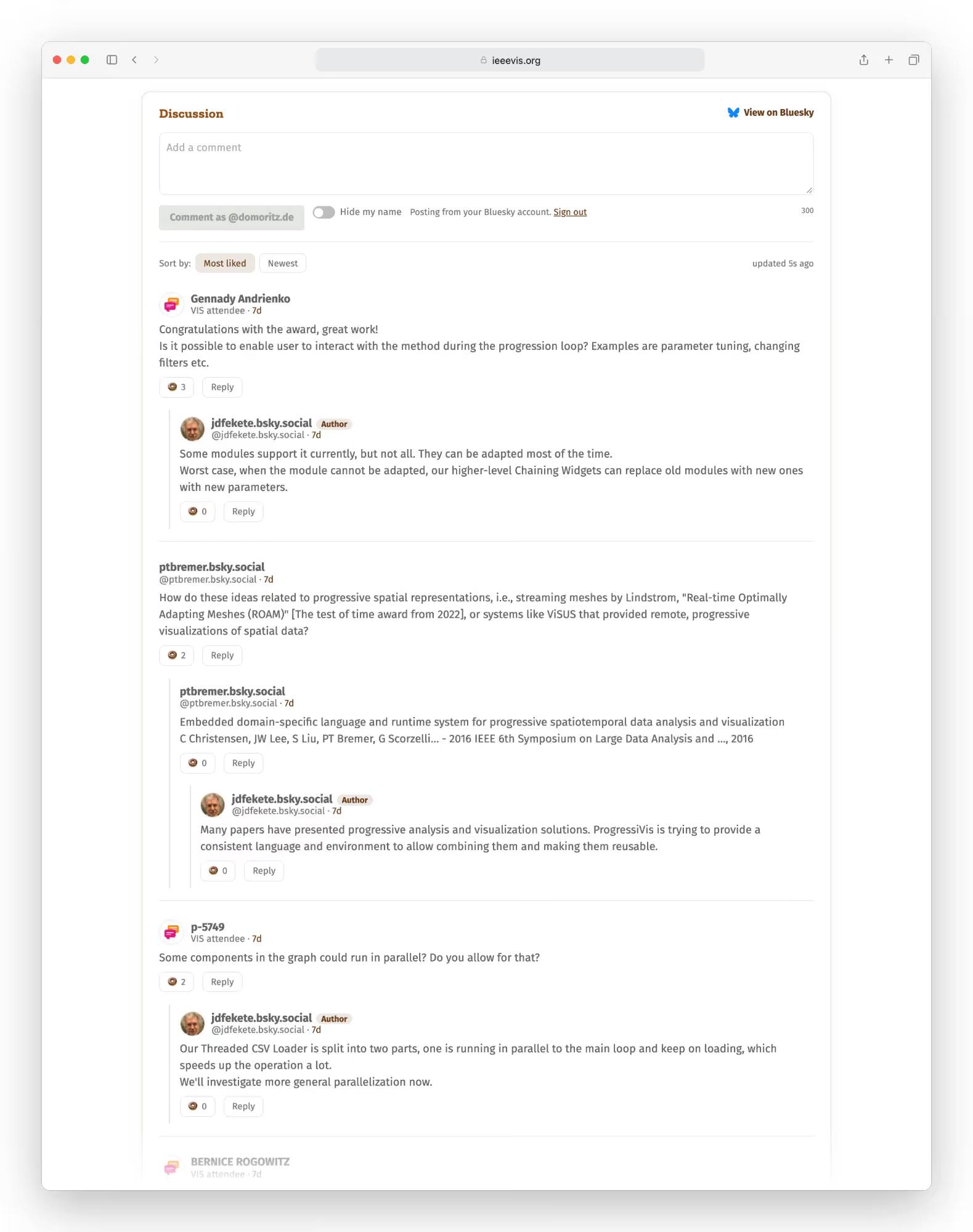
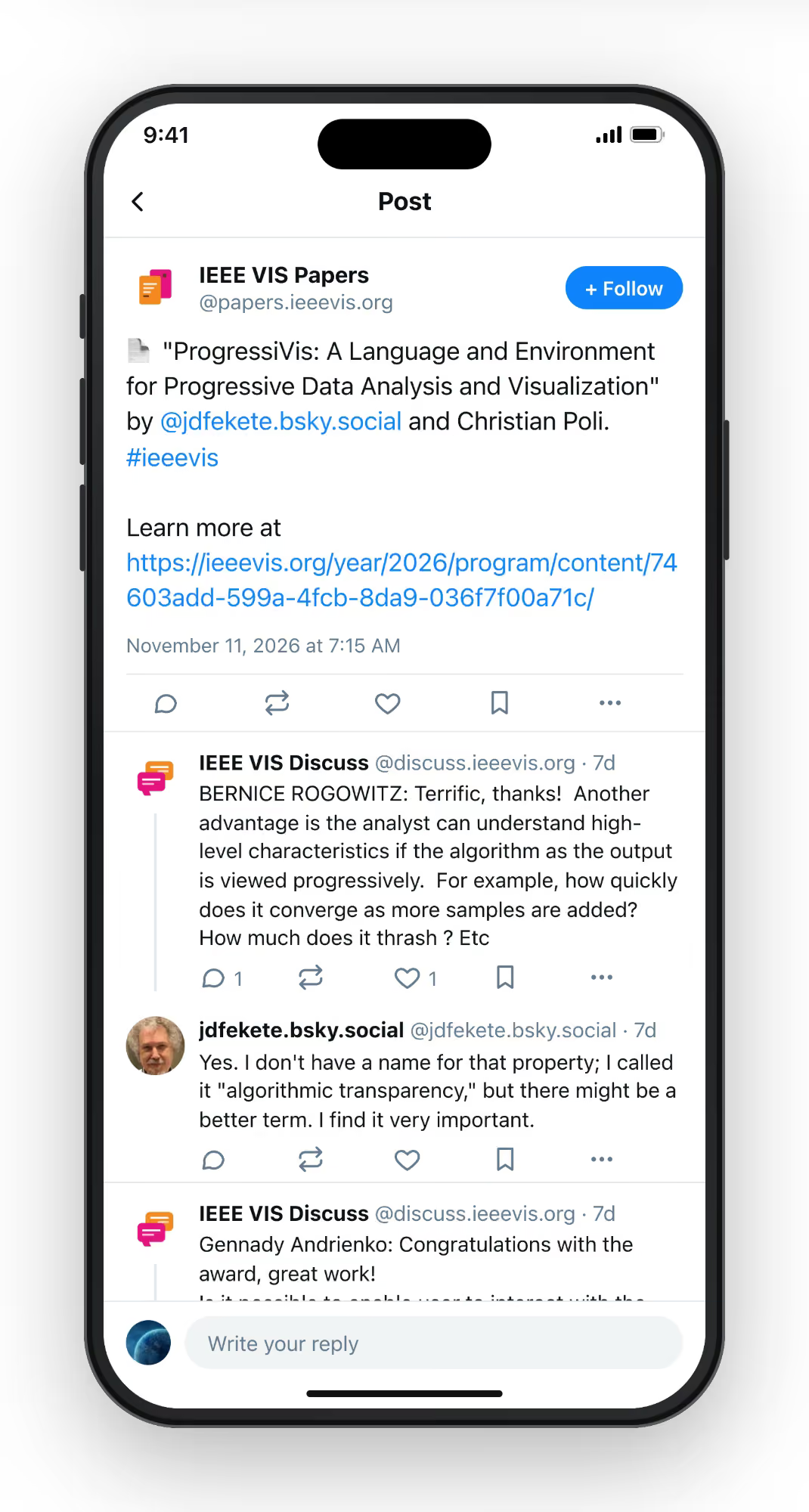
There usually isn’t much room for long discussions in a session. Online, people could ask more questions, authors had time to think about their answers, and the discussion stays around.
Lane Harrison was loving the Bluesky Q&A integration: “Good for sessions, good for post-talk discussion and connection, too.” Threads made room for things that don’t fit into a few minutes at the mic. Tamara had more of a comment than a question, “which is legit on Bluesky”. In-person Q&A only really has room for short clarifying questions but with the online discussion, we can ask questions, link to related resources, or even just praise the work to say how awesome or inspiring it is. Danielle Szafir followed up on a hallway chat after a talk, and people pointed to related work and materials. Jean-Daniel Fekete, for example, answered every question on ProgressiVis, including one with a reference to Knuth.
At the same time, not every discussion happened on Bluesky. People still asked questions live in the sessions, and not all sessions handled questions the same way. That is totally fine, and we need to learn over time which practices work best.
Session chairs are critical for making discussions work
Discussions worked best when someone actively ran them. Jason Dykes chaired a session and posted a prompt in each paper thread: “here’s your chance to engage in lively academic debate … and VOTE for your favourites! (then I get to ask them) (no need to be on BlueSky)”. The seven papers in his session averaged more than ten replies each. The other paper threads averaged just over one, and more than half had none.
The same goes for authors. Some answered every question, like Jean-Daniel Fekete on ProgressiVis or the HiLSVA authors, and some came back days later. But in about three quarters of the paper threads with questions, I could not find an answer from the authors. I followed up with the authors of a few of the most discussed papers without answers. In the end, we need to have enough momentum so that authors see value in answering questions and attendees see value in asking questions. This is something we will keep working on.
The timing of questions is tricky, too. I personally found it hard to write a question during a talk. I don’t want to ask something that the talk answers later, so I usually wait until the end. But that is exactly when the session chair looks at the discussion to pick a question.
We also improved our tools for session chairs based on their feedback. Chairs run their sessions with a tool that our tech team built. Several chairs asked to see the Bluesky discussion in this tool instead of opening the paper page on the VIS website, and we added it during the conference. Later, we also added a way for chairs to pin the question to ask next and to mark questions as answered.
Value for people who were not there
VIS this year was spread across Boston, Paris, and Tianjin, and the threads connected the locations. Arvind called it “an actual globally federated conference”, and Jason Dykes reported “a huge cheer at the end from 3 continents” for ProgressiVis. People who could not come at all followed along. Andy Kirk, as a “pre-occupied-with-other-stuff bystander”, called it a great success, and of value to us bystanders, and others missed how Twitter used to be a back channel during VIS but were happy to see it on Bluesky.
The discussions also reached beyond the research community. Chez Voila wrote that leaving a trace online signals “to the larger dataviz community, beyond IEEEVIS, that there is a commitment”. After a week of following the papers on Bluesky, Chez Voila asked how practitioners and researchers can work together, which started a thread that went on for days after the conference. VIS also tried to bring practitioners into the conference itself. This year’s program included Cluster, a summit for practitioners.
Bluesky as a platform for discussion rocks
Building on Bluesky meant we didn’t have to run a discussion platform ourselves and got moderation, scalability, and apps for free. The open API made it easy to integrate the discussions into the conference website and our conference management tools. It also made it easy for others to build on top. John Guerra built rankings, starter packs, a paper navigator, and the recap above. Matt Kay made a Bluesky feed for the conference. Rahat Zaman read my first post and added Bluesky discussions to their own publication pages. None of this needed the organizers.
One difficulty was following the conversation. Our more than 350 announcements also used the #ieeevis hashtag, so posts from people were harder to find, and muting the bot also muted the replies. Danyel Fisher suggested a separate hashtag for the announcements. Better ways to discover and organize the discussions are definitely something people will want.
Conclusion
Looking back at the design decisions from my earlier post, I think most of them held up. Building on Bluesky instead of rolling our own system worked, and now that the conference is over, we can turn off our posting and guest services and embed the Bluesky discussions directly. Letting people post without a Bluesky account worked too: 37% of the replies came through the guest bridge from 92 people, including session chairs who used it to run their sessions. Comments showed real names by default, with pseudonyms as an option, and both were used. Two thirds of guest comments were under real names, so the threads read like conversations between people. We had no issues with harassment. We were prepared with a moderation dashboard that let our student volunteers and ombuds hide or take down comments and de-anonymize people, but none of it was needed. Our community is awesome! Mentioning authors so they get notified also worked well in general, although many paper threads had no discussion, which is something to reflect on for future conferences. Finally, likes (or 🍩s, since we were in Boston) sorted the comments, and some session chairs, like Jason, explicitly asked the most liked questions. The town hall is a good example: attendees posted and liked questions about the satellite model, the conference location, and anonymous reviewing, many under pseudonyms, and the most liked ones rose to the top. The panel discussion in the VISions session collected 18 questions, more than any other thread, many of them longer reflections on friction, craft, and AI. So Bluesky can be a reasonable replacement for tools like Slido that let audiences ask and vote on questions.
Overall, I think the Bluesky integration worked well for VIS, but the work is not done. Building a community takes time and care. We need to establish practices over the years so that people learn, for example, how to chair a session or how to use the discussions in a workshop or panel. For the paper discussions, both authors and attendees need to see the value. This is a chicken-and-egg problem: authors need to answer questions so that attendees see value in asking, and attendees need to ask so that authors see value in answering. The threads where both were engaged were amazing to see. Bluesky and Cluster were both experiments at VIS this year, and both reached beyond the research community. We will discuss with the organizing committee for 2027 which parts to continue, reduce, or expand.
And to end, thanks to everyone who made this experiment a success: the web and tech teams who worked closely together to make the integration work, the session chairs, Jim Ray and Bluesky for the quick unsuspension, John for the analysis, and the amazing community of attendees, authors, and others on Bluesky who discussed papers, research, practice, and grounded airplanes.